
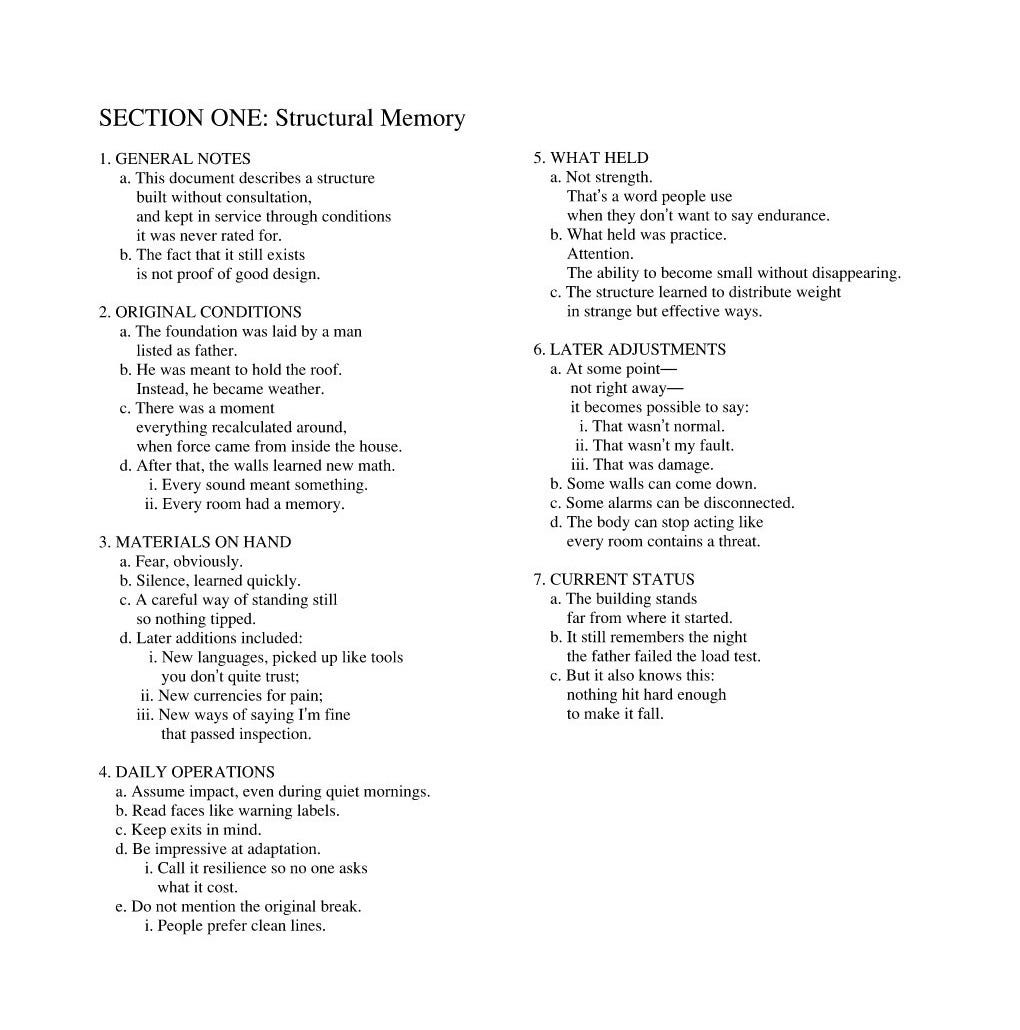
Section One: Structural Memory
What survives when the original design fails


1. GENERAL NOTES
a. This document describes a structure
built without consultation,
and kept in service through conditions
it was never rated for.
b. The fact that it still exists
is not proof of good design.
2. ORIGINAL CONDITIONS
a. The foundation was laid by a man
listed as father.
b. He was meant to hold the roof.
Instead, he became weather.
c. There was a moment
everything recalculated around,
when force came from inside the house.
d. After that, the walls learned new math.
i. Every sound meant something.
ii. Every room had a memory.
3. MATERIALS ON HAND
a. Fear, obviously.
b. Silence, learned quickly.
c. A careful way of standing still
so nothing tipped.
d. Later additions included:
i. New languages, picked up like tools
you don’t quite trust;
ii. New currencies for pain;
iii. New ways of saying I’m fine
that passed inspection.
4. DAILY OPERATIONS
a. Assume impact, even during quiet mornings.
b. Read faces like warning labels.
c. Keep exits in mind.
d. Be impressive at adaptation.
i. Call it resilience so no one asks
what it cost.
e. Do not mention the original break.
i. People prefer clean lines.
5. WHAT HELD
a. Not strength.
That’s a word people use
when they don’t want to say endurance.
b. What held was practice.
Attention.
The ability to become small without disappearing.
c. The structure learned to distribute weight
in strange but effective ways.
6. LATER ADJUSTMENTS
a. At some point—
not right away—
it becomes possible to say:
i. That wasn’t normal.
ii. That wasn’t my fault.
iii. That was damage.
b. Some walls can come down.
c. Some alarms can be disconnected.
d. The body can stop acting like
every room contains a threat.
7. CURRENT STATUS
a. The building stands
far from where it started.
b. It still remembers the night
the father failed the load test.
c. But it also knows this:
nothing hit hard enough
to make it fall.
First published in Fahmidan Journal, Issue 25
As always, a huge THANK YOU for taking the time to read my poem. Without you, my voice would be a whisper just floating in the air.
Author’s Note: For those who may not know, I’ve spent a lifetime in design and construction, working as part of teams that have created some truly impressive structures, everything from roadways and bridges to academic and research facilities. Over the years, a significant part of my job has involved writing or interpreting design specifications. They’re as familiar to me as light is to a plant, breath to the body.
A few months ago, I attended a poetry reading featuring a unique writer who presented poems in unconventional formats. One was structured like a business email, another like a text exchange. I also recall Kate Baer using medical documents as a form in her book “How About Now.” That got me thinking: what could I use to bring something different to my own writing? The answer came quickly.
This is my first attempt at using that form.
I’d love to hear your thoughts, whether it was easy to follow, or whether the structure felt more like a distraction than an enhancement.
This poem is part of a miniseries about my relationship with my father and my time growing up. Here are the previously published poems in the series:
“he was meant to hold the roof, instead he became weather.” I relate to this. This is a powerful piece, I love the way you’ve structured it, so creative and clever
An amazing poem. You've packed so much into this, emotion and history. Effective and impactful. This form was an excellent vehicle. Thank you